
In Victoria’s competitive tourism landscape, where Butchart Gardens and the Inner Harbor command visitor attention, a unique paleontology experience has quietly emerged as one of the region’s most authentic destinations. Dino Lab Inc., operating from James Bay, represents something unprecedented in the tourism sector: a fully operational fossil restoration laboratory that has successfully transformed scientific work into an immersive public experience.
From Scientific Necessity to Tourism Innovation

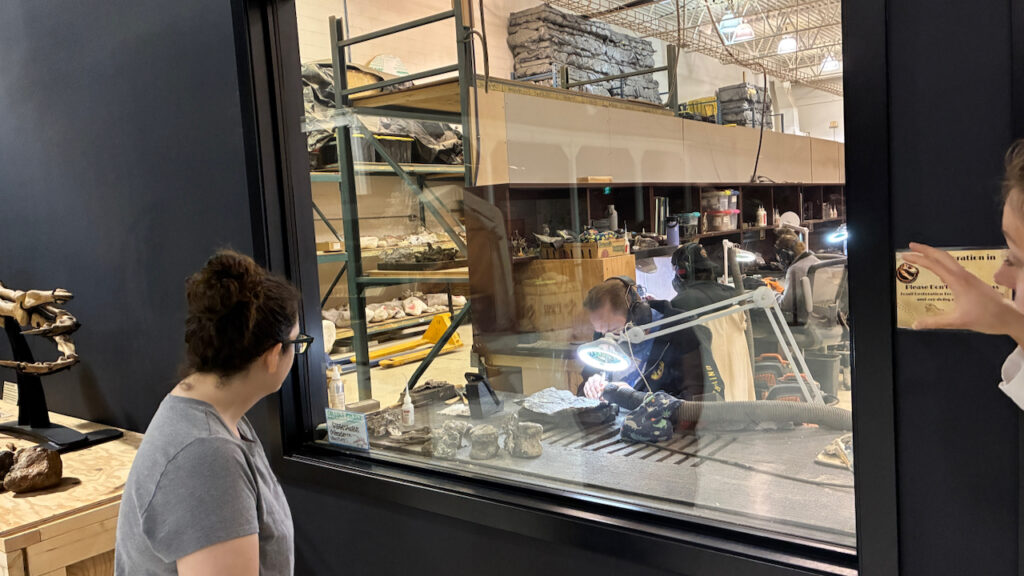
What began in 2004 as Pangea Fossils, a specialized fossil restoration company serving international museums, evolved into something far more significant when co-owners Terry Ciotka and Carly Burbank recognized an unexpected opportunity. The transformation wasn’t planned.
As one of only two companies in Canada capable of museum-quality fossil restoration, Dino Lab’s client roster includes prestigious institutions like the Royal Tyrrell Museum, Royal Ontario Museum, Houston Museum of Natural Science, and Berlin Natural History Museum. The laboratory has completed over a dozen full skeleton restorations, including four T. rex specimens now displayed globally.
But it was overwhelming public curiosity about their work that sparked the tourism pivot. “Back in 2018,” Burbank recalls during an exclusive interview, “we had our kids’ teachers and friends and family all wanting to come for tours and then they’d get friends and family and then it was really pulling on our deadlines. And I thought, okay, people are interested, they love it. They love having the tools in their hands. Let’s do this. Let’s have it hands on.”
Rather than viewing this interest as a disruption, Burbank saw an opportunity to create something unique in the tourism landscape, driven by her background in arts education. “My background is art school and I want to touch carvings and I want to touch paintings and you can’t do that, which I understand, but you can with fossils,” she explains.
The 90-Minute Hands-On Experience

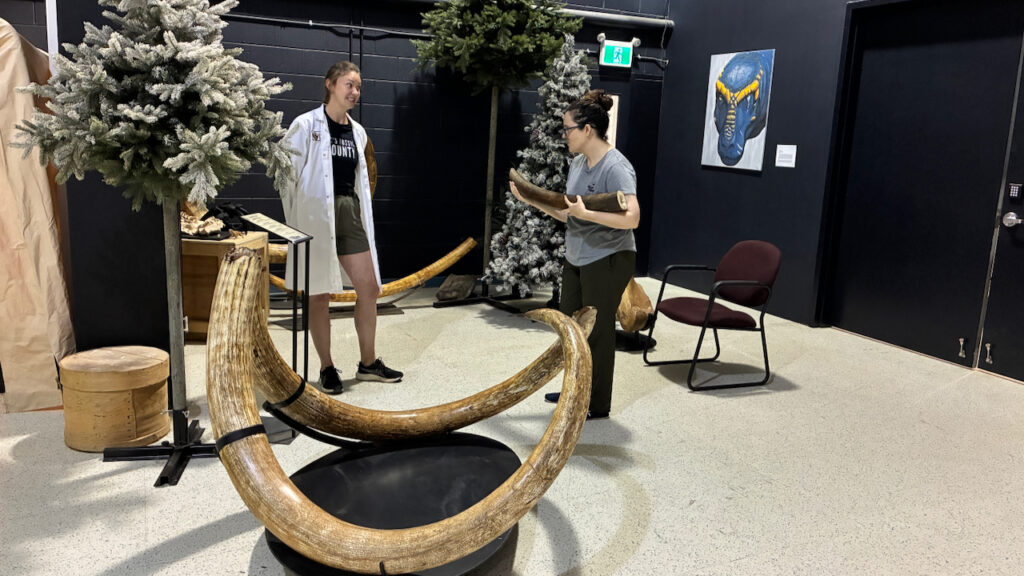
Dino Lab’s “Dinosaur Experience” offers multiple tour formats designed to accommodate different visitor preferences. Mixed-age tours accommodate up to 15 people ages 4 and above at $40 per person, while adult-only sessions provide focused experiences for mature audiences seeking deeper scientific engagement. Private group tours serve up to 15 participants for $375, offering customized experiences for families or educational groups. The facility also hosts birthday parties and offers “Prehistoric Preschool” programs, with recent expansion adding more preparation stations to accommodate larger groups and field trips.
The 90-minute experience includes a private gallery tour, hands-on fossil preparation work, and supervised interaction with authentic specimens. Safety protocols require masks during fossil preparation work, and children under 4 are restricted from laboratory areas due to safety considerations.
“I wanted the tactile experience to come across to people and I feel like when people can get their hands on things, it sparks something that looking at it never will or reading about it never will,” Burbank emphasizes.
The facility maintains sophisticated handling protocols that vary based on specimen rarity, preservation quality, and visitor demographics. “It depends on the quality of the bones. How much of the matrix is there? How delicate the bone is if it’s a meat eater versus a herbivore. Their bones are preserved differently,” Burbank explains. “So there’s some things where they just can’t be handled or the oils on your hands will change the coloring. Also how common the bone is.”
While rare discoveries remain protected, common specimens like T. rex femurs and triceratops bones become interactive teaching tools. “If it’s like a T-Rex femur or something from a triceratops, lots of those available, almost indestructible depending on where they were found, so absolutely no harm in touching them.”
Complex Logistics Behind the Scenes

The path from fossil discovery to public display involves intricate international logistics that few visitors realize. “It can take years to get out because you’ve only got the thawed months to dig,” Burbank explains. “So then you’ve got to get it jacketed and in storage right away and then get it shipped, which is always a process. Insurance and customs and getting it across the border because people don’t believe what you say it is.”
The customs challenges can be particularly amusing. “We’ve even had calls where we had fish and wildlife experts at the border asking us if the fossilized crocodile skull that we were bringing across was legal and it’s very much fossilized, so we didn’t kill it. Just that kind of stuff. It’s always kind of an adventure.”
Despite these challenges, the process enables remarkable international collaborations. Burbank describes their Australian partnership: “With Australia, that’s how we found them the Triceratops. They were actually looking for a T-Rex first and that deal fell through because like anything that’s going through a government-funded thing takes a while. So the timeline passed, the landowner wanted to get rid of it quicker. They sold it to somebody else. But then we had the Triceratops come up and it was just phenomenal quality.”
Strategic Location and Market Positioning
Dino Lab’s James Bay location presents both challenges and advantages in Victoria’s tourism ecosystem. The facility moved from an initial location near Mayfair Mall that Burbank describes as problematic: “It was actually a rather unsafe area. But when we first opened, we didn’t want to be known to the public. We were just doing the restoration. We didn’t want people to know that we’re working on a T-Rex behind those big bay doors.”
The current location required creative real estate navigation. “Victoria is very strange in that we don’t have a central website that has all the home listings or all the commercial space listings. So you have to go to each Realtors site and then they’ll cherry pick what they will show you,” Burbank notes. “So I wasn’t being shown anything. And so I just started kind of digging and digging and Googling and driving around and this place popped up.”
The current location provides operational and staff benefits that extend beyond tourism. “I love our downtown. Our downtown is so unique. James Bay is incredible,” Burbank explains. “I find it’s great for our staff, for morale. They can go outside at lunch. They can walk over to the wharf, get some fresh air.”
Marketing Challenges and Discovery Methods
Dino Lab tracks visitor discovery methods to optimize marketing investments. “I have all of our guides track that because the first few years I felt like I was just throwing money into the abyss and hoping it would stick with advertising and you never know,” Burbank reveals. “Now it’s come down to we notice a direct correlation to Instagram posts. I do want to do paid posts on Instagram, the parades and any outreach activities that we do where we’re out there being visible in the public.”
The facility employs creative promotional strategies, including an ambitious inflatable dinosaur costume program for parades. “I’ve probably gone through 60 to 100 since we opened it’s ridiculous,” Burbank laughs. “The quality on the fans is hot garbage. So we’ve done so many parades with them and they generally some will last an entire parade. Some won’t somebody will put one on with their shoes on and wreck the elastic around the ankle.”
For 2025, they’re transitioning to a more sustainable approach: “This year I got a 3D prints expert, he’s doing our model kits and he’s going to 3D print realistic, fantastic looking skulls onto bike helmets for us for our pride parade and moving forward so we can just forego most of the inflatables.”
Building Regional Science Networks
Dino Lab’s community integration extends beyond tourism through initiatives like Passport to Science, a collaborative program connecting STEAM organizations across Vancouver Island. The program launched in 2023 through a partnership between Dino Lab’s Kalene and the Dominion Astrophysical Society, aiming to make science accessible while reducing financial barriers for families.
“Kalene started an initiative. She came to us from the Swan Lake Nature Sanctuary and she also worked at the Bug Zoo. And she started an initiative called the Passport to Science, which is a bunch of organizations, STEM organizations that come together and donate their time to allow the public to come in and kind of get a taste of what all these places have to offer at no cost,” Burbank explains.
Since its pilot launch, Passport to Science has hosted three free science events, distributed 1,500 passports containing science challenges and organizational discounts, and collaborated with 17 STEM organizations from Victoria to Coombs.
Educational Philosophy and Market Positioning
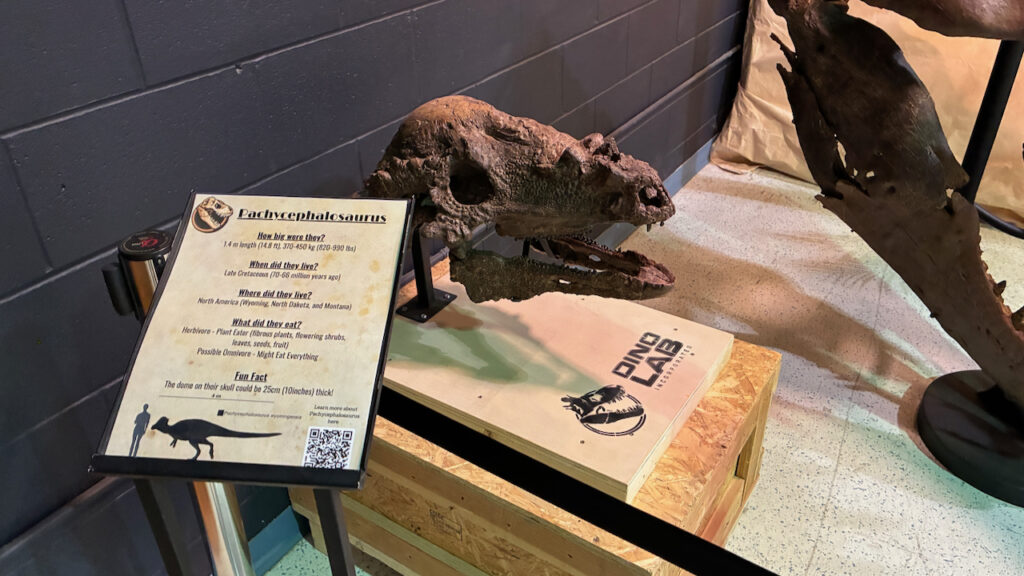
Burbank is particularly passionate about challenging traditional perceptions of paleontology. “I’m particularly passionate about making STEAM fields more accessible for women and breaking the stereotype that dinosaurs and paleontology are just for kids and boys,” she states.
The facility operates within a global paleontology market experiencing dramatic growth, though Dino Lab’s business model differs significantly from high-profile auction sales. “We try everything we can to initially get our pieces into public museums, then approach private ones, then collectors, trying to go with ones that we know will generally donate or lend those specimens to a museum,” Burbank explains. “Our goal is always to try our best to have these pieces accessible to public museums as much as possible.”
This museum-first approach has resulted in notable placements like Tristan Otto and Amelie, among others, ensuring that restored specimens remain accessible for scientific study and public education rather than disappearing into private collections.
However, local market challenges persist. “We need the support equally of the locals and of tourists,” Burbank emphasizes. “One thing I have noticed in Victoria is a lot of really phenomenal, really unique places have closed, especially since Covid. And yet always here, ‘Oh my God, I can’t believe it’s closed. That was my favorite. That was my favorite place to eat, my favorite place to go.’ And that’s what happens, unfortunately, you know, with the cost of leasing space. People just you need the support that you simply can’t stay open.”
The Broader Significance

Dino Lab represents an emerging model for science-based tourism that addresses several contemporary challenges simultaneously. In an era when science education faces resource constraints, the facility creates financially sustainable science engagement reaching diverse audiences through commercial rather than institutional channels.
“There’s just so many things that can be done with collaboration versus gatekeeping,” Burbank concludes, reflecting on their international partnerships and community integration efforts.
For tourism strategists and community planners, Dino Lab offers compelling insights into how specialized businesses can transcend traditional tourism limitations when they understand expertise as cultural resource rather than operational capability. The facility proves that authentic scientific work can become the foundation for premium visitor experiences while maintaining research credibility and community integration.

Dino Lab Inc. is located at Unit #100, 43 & 45 Erie Street in Victoria’s James Bay district. Tours are limited to 15 participants and advance booking is required with a minimum two-hour notice. The facility operates year-round with seasonal hour variations and offers birthday parties and Prehistoric Preschool programs. For more information, call 778-966-3466.


