

Twinings has been at 216 Strand since 1706. That’s not marketing copy. It’s the actual foundation of how the store operates today. The address itself has become inseparable from the product, and when you walk through the shop, you see that strategy everywhere.
The tote bags say “TWININGS 216 STRAND LONDON” in gold lettering. The t-shirts reference the address. The packaging reminds you this tea comes from the place that’s been selling it since 1717. Twinings isn’t just selling tea. It’s selling the fact that you bought it from the historic flagship location.
The 1717 Innovation
Thomas Twining opened “Tom’s Coffee House” at 216 Strand in 1706. Women could enter unescorted, which was unusual for London coffee houses. But the real business innovation came in 1717, when Twining started selling dry tea for customers to take home instead of just serving it by the cup.
Before this, tea was primarily consumed in coffee houses. Twining turned it into a packaged retail product. That shift created the foundation for British tea retail, and 216 Strand became the flagship for the entire category.
The current shopfront, with its golden Chinese figures, dates to 1787 and hasn’t changed much since. The space itself is modest, a classic London shop layout with checkered floors and wood fixtures, but it’s been continuously operational at this exact address for 318 years.
Destination Merchandising: The Address IS the Product
What’s interesting about Twinings is how thoroughly they’ve turned the 216 Strand location into merchandisable equity. This isn’t subtle. It’s the primary strategy.
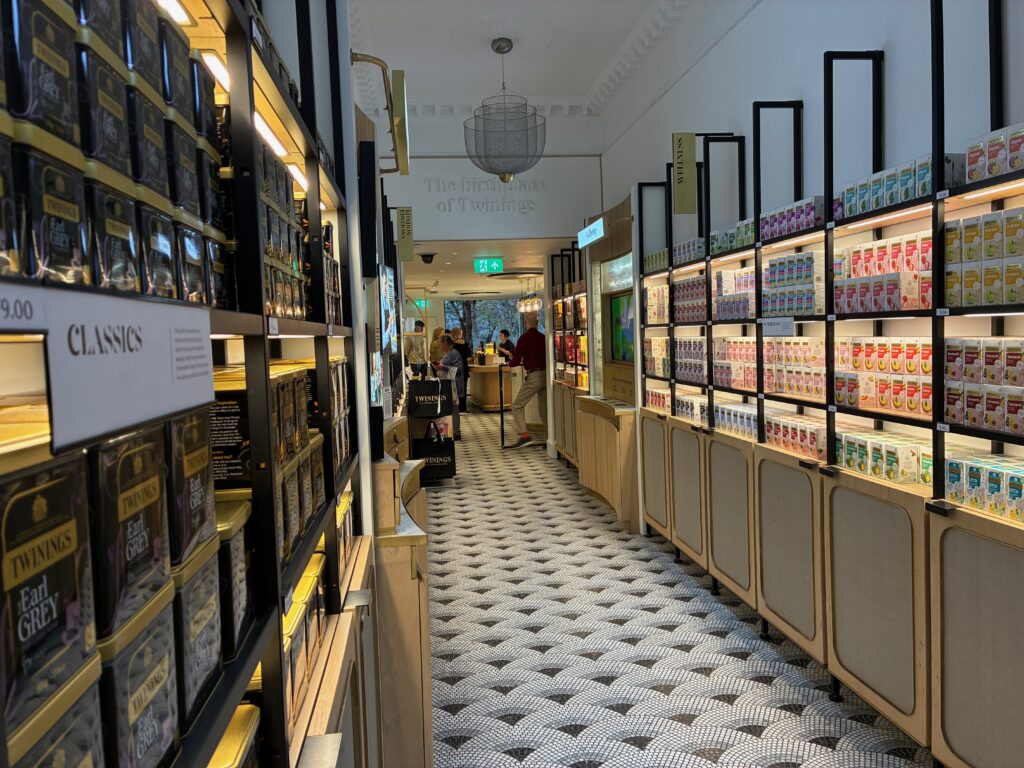
The Tote Bag Strategy
Those black tote bags branded “TWININGS 216 STRAND LONDON” aren’t just shopping bags. They’re merchandise. Customers buy them as souvenirs because carrying a bag with that specific address signals “I went to the historic flagship.” The address does the work. It’s not “Twinings London” or “Twinings Tea Shop.” It’s 216 Strand, the location that’s been there since 1706.
This works because the address has genuine meaning. You can buy Twinings tea at any Waitrose or Sainsbury’s in Britain. But you can only buy it from 216 Strand at 216 Strand. The location becomes the differentiator.
“The Perfect Gift” Positioning
The merchandising explicitly frames purchases as gifts rather than personal consumption. That marble counter display shows tea accessories, strainers, infusers, small items at £7 each labeled “Little treats for tea lovers.” These aren’t essentials. They’re gift add-ons that increase transaction value.
The logic: if you’re a tourist buying tea for friends and family, you’re already in gift-buying mode. The accessories extend that purchase behavior. You came for a £12 tin of Earl Grey. You leave with the tin, plus a strainer, plus a tote bag. Transaction value just tripled.
Heritage Through Branded Apparel
The t-shirts and apparel with Twinings branding turn customers into walking advertisements, but more importantly, they’re proof of visit merchandise. Wearing a Twinings shirt signals “I went to the London flagship,” the same way people wear Hard Rock Cafe shirts from specific cities.
This only works because 216 Strand has 318 years of history backing it up. A new tea brand couldn’t sell location-branded apparel. There’s no heritage to reference. Twinings can, because the address itself carries weight.
Why Tourists Seek This Specific Location

People don’t search “tea shops near Westminster.” They search “Twinings 216 Strand” and navigate to this exact address. The location has become the destination.
The royal warrant “By Appointment” plaque signals quality and institutional endorsement. If it’s been acceptable to 17 British monarchs across three centuries, it’s probably good tea. That credibility is built into the location itself.
For international visitors, this represents authentic London heritage. The Georgian shopfront, the golden lions, the hand-painted signage: it looks like what people imagine historic London should be. But unlike a museum, you can participate by making an actual purchase. You’re doing the same transaction that’s happened at this address since 1717.
The Masterclass Strategy: Turning Retail Space Into Revenue-Generating Experience
While most heritage retailers stop at product sales, Twinings operates a full tea masterclass program in a dedicated tasting room beneath the shop. This isn’t a tour or a museum walkthrough. It’s a paid educational experience that runs most days of the week and generates additional revenue from the same flagship footprint.
The Offering:
- Classic Masterclass: £50 per person, 2 hours
- Spring Steeping seasonal events: £60 per person (£100 for couples)
- Bespoke Blending Sessions: £350 per session, including 1kg of custom-blended tea
- Corporate and private events available after hours
The masterclass does three things at once. It deepens customer engagement with the brand. It creates a higher-value transaction than retail alone, £50 against a £12 tea tin. And it transforms the flagship from a shopping stop into a destination worth scheduling around.
Why This Works at 216 Strand:
The masterclass isn’t just tea education. It’s access to the historic location itself. You’re tasting tea in the basement of the building where Thomas Twining sold tea in 1717. That context elevates the experience beyond what a tea brand could offer at a rented event space in Shoreditch.
The tasting room seats 10 guests, which creates intimacy and exclusivity. Sessions run most afternoons, meaning Twinings captures revenue from the space during hours when retail traffic might be slower. A masterclass customer spends £50 on the class, plus likely buys tea to take home. Total transaction value easily reaches £70 to £80, compared to the average retail purchase of £15 to £20.
The Corporate Play:
The after-hours private events are particularly smart. Companies can book the entire 216 Strand location for team-building, client entertainment, or networking events. This monetizes the space outside retail hours and positions Twinings as a London venue, not just a shop. Pricing is on request, but corporate event budgets in London easily run £2,000 to £5,000 for small groups, far more profitable than selling tea tins.
What This Reveals About Destination Retail:
Heritage retailers often treat their historic locations as simply the place where transactions happen. Twinings recognized that the location itself, 318 years at 216 Strand, has value beyond being a backdrop for product displays.
The masterclass turns “we’ve been here since 1706” from a fact into an experience you can purchase. Tourists don’t just buy tea at the historic flagship. They can spend two hours learning tea history in the actual historic building. That’s destination monetization, not just destination marketing.
The Missed Opportunity in Other Heritage Retail:
How many historic London shops have basements sitting unused, or turned into stockrooms? Fortnum & Mason has restaurants, but most heritage retailers haven’t figured out how to extract additional value from their historic real estate beyond retail transactions.
Twinings proved you can run an educational program, charge premium prices, and use the same space that’s already part of your flagship footprint. The masterclass doesn’t require additional street-level square footage. It happens in the basement that was already there.
This is the insight most heritage brands miss: your historic location isn’t just where you sell products, it’s the product itself, and you can sell access to it multiple ways, retail, experiences, events, and corporate bookings, all from the same address.
The Souvenir Logic
For £10 to £15, you get a tin of Earl Grey with royal warrants on the label, packaged in gift-ready boxes. It’s an authentic British product with legitimate 318-year heritage that you can actually use. That’s a rational souvenir, not a miniature Big Ben that sits in a drawer forever.
The tea is genuinely good because Twinings has production relationships with estates across India, Sri Lanka, Kenya, and China built over generations. The Earl Grey blend was created for the 2nd Earl Grey in the 1830s. The English Breakfast has been refined for nearly two centuries. When you buy Twinings here, you’re getting formulations that have been adjusted over 190 years, not a tea brand’s recent interpretation of “what Earl Grey should taste like.”
What This Location Does Differently

Two Customer Segments, Same Space
The gift-focused merchandising near the entrance serves tourists making quick purchases: grab a tin, maybe add accessories, pay, leave. Three-minute transaction.
The loose-leaf tea section deeper in the shop serves actual tea enthusiasts who understand growing regions, harvest seasons, and the difference between Assam and Darjeeling. These are often Londoners who trust Twinings to source properly. Ten-minute browsing session, conversations with staff about specific teas.
Both segments coexist because the merchandising is zoned clearly. Tourists get their souvenirs without disrupting serious tea buyers exploring premium selections.
Modern Retail in a Historic Shell
The contemporary fixtures, curved marble counters, clean white walls, organized black shelving, show that Twinings isn’t trying to recreate Victorian atmosphere. The history is in the address and the product, not in artificial period decoration. The retail experience is current.
This matters because too many heritage retailers get stuck performing “old-fashioned shopkeeper” theater that feels disconnected from how people actually want to shop. Twinings maintains the heritage through the location and the tea itself, while keeping the retail operation contemporary and efficient.
The Address as Competitive Advantage
Twinings could open additional London locations with the same product range. They could expand to Oxford Street or Covent Garden with more square footage and higher foot traffic. They largely don’t, because spreading out would dilute what makes 216 Strand valuable.
The scarcity is strategic. There’s only one 216 Strand. That makes it a destination worth seeking out, which makes the address itself merchandisable. The tote bags, the apparel, the “I bought this at the flagship” narrative all depend on there being one special location that’s been there for 318 years.
What Makes This Work

The destination merchandising succeeds because the heritage is genuine. You can’t manufacture “318 years at the same address.” New tea brands can’t replicate this strategy because they don’t have the history to back it up.
The address equity, turning 216 Strand itself into a merchandisable asset, only works because Twinings has been there continuously since 1706. The location isn’t just where the shop happens to be. The location is the product.
Rating: 9/10
The strategy of merchandising the address itself, tote bags, apparel, “bought it at 216 Strand” positioning, is exceptionally well executed. The integration of modern retail fixtures with historic location equity keeps the experience relevant without feeling like heritage theater.
Study this if: you’re working with a heritage brand trying to figure out how to make “we’ve been here forever” into actual merchandisable value, or you’re trying to understand how destination retail works when the destination itself is the competitive advantage.
