
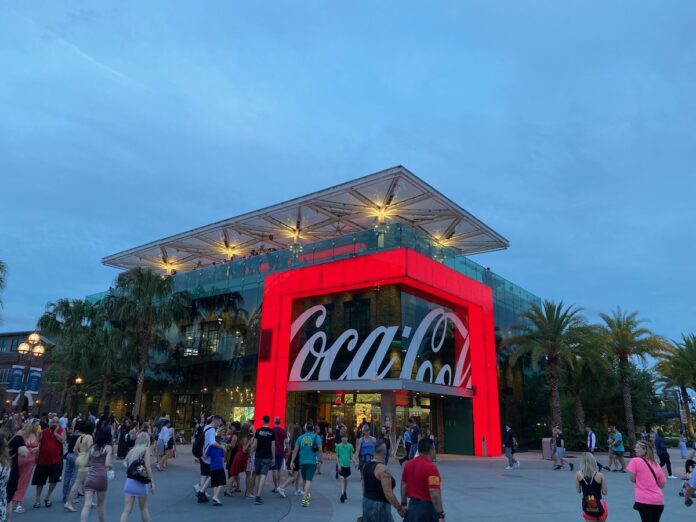

Patrick Kells was Coca-Cola’s Director of Retail Merchandising when the Disney Springs store was being designed. His brief to the team was direct: “It wasn’t just a retail store. Our main objective was making sure that people had a great experience.”
He also defined what success looked like, and it wasn’t a sales figure. It was guests immediately picking up their phones to post about it, and wanting to bring other people back to experience what they had just experienced.
That brief was written before a single product was ordered or a shelf was placed. It’s why the Coca-Cola Store at Disney Springs still works the way it does nearly a decade later. And it’s the thing most brands and venues get backwards.
A logo on a building doesn’t make people walk in. A recognizable product doesn’t make people stay. You need a draw. And the draw requires genuine, upfront investment in the kind of experience infrastructure that makes a retail space feel like somewhere worth going, not somewhere you happened to pass.
The Decision That Made Everything Else Possible

Before Coca-Cola thought about what to sell, they thought about what to build.
Ford AV, a professional AV integration firm with prior experience on Coca-Cola’s Las Vegas store and the World of Coca-Cola museum in Atlanta, was brought in at the design stage. Not after construction. Not to solve a problem. Senior Account Manager Michael Burton worked with Coca-Cola and design firm IDL Worldwide in whiteboard sessions to figure out what the Polar Bear Experience would actually feel like before the building was finished.
That timeline matters more than any single decision that followed. The experience infrastructure wasn’t fitted around the retail space. The retail space was built around the experience.
What they constructed on the second floor: an 18×1 ribbon video wall of Planar displays in portrait orientation showing the polar bear welcoming guests into his habitat. Fourteen floor-embedded video screens showing arctic animals swimming beneath your feet while you waited in the queue. Kells described it plainly: “you don’t know you’re in a queue because you’re walking on a video platform.” A custom liquid nitrogen fog system. A pair of Rosco X-Effects projectors creating a live Aurora Borealis effect on a specialised projection surface. Six Martin theatrical wash fixtures. Interactive frost touchscreens where guests could wipe away ice to reveal polar bears underneath. A Reflecmedia chroma-key screen for professional photography. An Alcorn McBride show control system tying all of it together, with custom music composed specifically for the show. Crestron control on every floor. Timed show schedule, multiple times a day, theatrical entrance, lighting changes, music cues, haze, and the bear materialising out of the aurora effect.
This is not retail design. This is attraction design. The budget, the team, the timeline, and the technical specification are consistent with what you would find inside a theme park, not a gift shop.
That was entirely the point.
Why the Investment Drives the Revenue
Here is what happens when you spend that kind of money on an experience inside a retail store: the entire commercial logic of the space changes.
Guests walking into a standard brand retail environment are in shopping mode. They are evaluating product, comparing prices, deciding whether they need something. The mental calculus is transactional. They buy or they don’t, and either way they leave.
Guests walking into a space where the floor is a video screen showing arctic animals swimming beneath them, where fog rolls in and a seven-foot polar bear materialises out of an Aurora Borealis effect, where the show was built to theme park technical specification, are not in shopping mode anymore. They are in experience mode. People in experience mode buy differently. They buy more. They buy to commemorate rather than to acquire. They photograph it, post it, and tell other people about it, which is exactly what Kells named as the success metric.
The merchandise on the ground floor benefits from this whether or not the guest went upstairs. Knowing there is something genuinely worth seeing inside the building makes the whole space feel more deliberate, more worth engaging with. You stop longer at the display table. You notice the “Coca-Cola Store Exclusive” badge on the mug wall in a way you wouldn’t in a space that felt like just another shop.
The rooftop bar benefits from the same halo. Guests who have just had a real experience somewhere are primed to extend it. Climbing to the third floor for a Beverly from Italy or an Inca Kola float feels like a natural next chapter, not a detour.
The experience at the centre raises the emotional temperature of the whole visit. Every revenue layer that follows runs warmer because of it.
The Layers That Keep Running
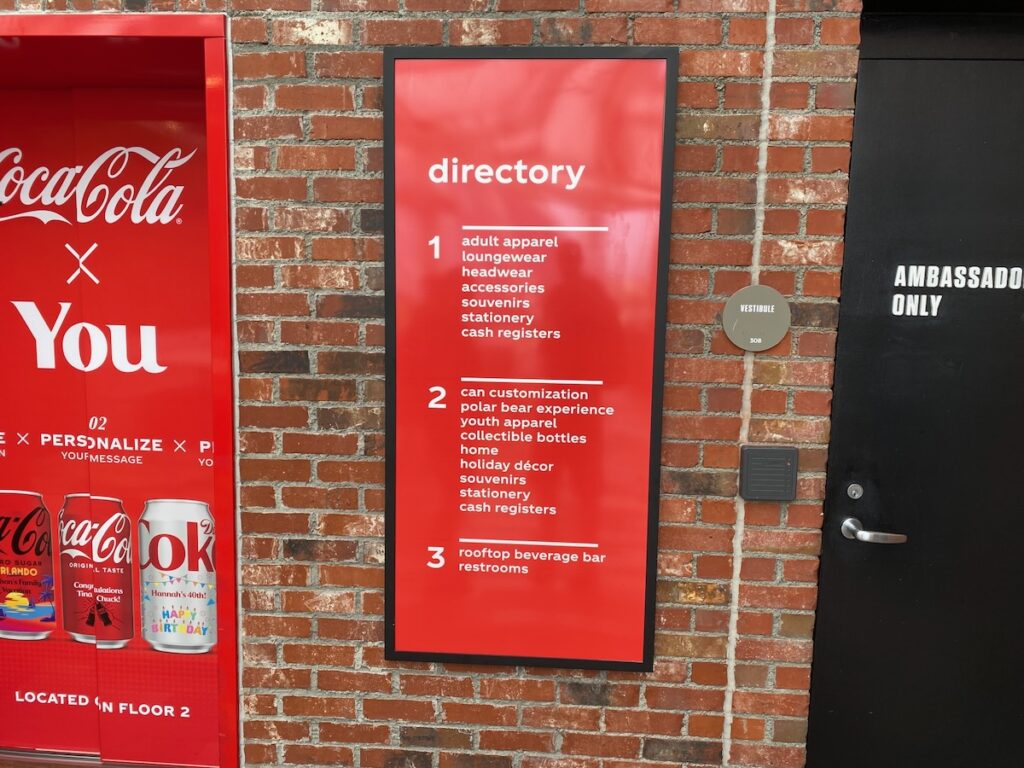
Once you have the draw, the other revenue layers have room to work.
I’ve visited this store several times. The ground floor runs on volume and impulse. The 30-foot chandelier made from repurposed Coke bottles anchors the central table and pulls guests toward the best-sellers. Apparel, drinkware, socks, keychains at $4.95, a $10-and-under zone running the length of the checkout counter. Every price point is covered, and the floor layout means almost nobody leaves empty-handed.
The second floor serves a different buyer. Slower, more deliberate, higher spend. Die-cast Coca-Cola delivery trucks. Funko Pops. Jigsaw puzzles. Enamel pins. A collectibles wall that takes time to work through. The can customization station, where at $7.95 you can print your name, a date, a nickname, or a message on a Coke can and leave with something that didn’t exist before you walked in.
That last one is worth stopping on. It converts a commodity product into a personalised souvenir, which is a genuinely different category of purchase. The display case of completed examples does all the selling without any staff involvement. You see “Windish Family Vacation, Orlando” on a can and you immediately understand what you are actually buying. Not a Coke. A record of the day you were here.
The rooftop bar is its own destination. Open air, views across Disney Springs, a menu built around the international Coca-Cola portfolio. Beverly from Italy. Inca Kola from Peru. Sparletta from Zimbabwe. Fuse Tea. Mocktails. Floats. A rotating drink of the month promoted on a sandwich board at street level, before you have even decided whether to go in. The rooftop has its own revenue stream, its own reason to visit, and guests pass through both retail floors to reach it and to leave.
Then there is the collaboration calendar, which is the mechanism that keeps all of it fresh. On my most recent visit: Coca-Cola x Oreo (“Besties Forever, Limited Time”), Coca-Cola x Crocs displayed in acrylic cases like sneaker drops, Coca-Cola x Champion, Coca-Cola x Spirit Jersey, and the permanent Coca-Cola x Walt Disney World co-branded line. Each collaboration serves a different buyer. The Oreo partnership catches the person who wants something culturally current. The Crocs are for collectors. Champion and Spirit Jersey are for the guest who wants premium apparel they will actually wear outside of Orlando. The Disney co-brand is the one that only exists at this location, the dual-logo item that couldn’t come from anywhere else.
The physical footprint of the store doesn’t change. The floor changes every few months. Repeat visitors have a genuine reason to come back. First-time visitors have a genuine reason to buy now, because “Limited Time” on the Oreo display is doing exactly what it says.
This is the streetwear drop model applied to brand flagship retail. It works for the same reason it works in streetwear: scarcity and novelty move product faster than selection and convenience.
What This Means If You’re Running a Venue

The lesson here is not really about Coca-Cola. It is about sequencing.
Most brand retail in venue environments gets built in the wrong order. The space gets designed, the brand fills it with product, and then someone asks whether there should be something experiential in the corner. That order produces spaces that feel like what they are: shops that tried to add a draw after the fact.
What Coca-Cola did was hire Ford AV before the building was finished. Whiteboard sessions about what the experience would feel like happened before floor plans were settled. The attraction came first. The retail wrapped around it. The floor-embedded screens, the custom show control, the LN2 fog, the Aurora Borealis, none of that is decoration. It is the foundation that every other revenue layer sits on.
A stadium operator building a new team store, a museum developing a retail partnership, an airport expanding its duty-free footprint: the question worth asking before anything else is not “what will we sell” but “what will make someone seek this space out.” If the answer is just the product or the brand name, the space will underperform. The brand name gets people to glance at the building. The experience is what gets them through the door, up three floors, back next visit, and posting about it on the way out.
Coca-Cola was willing to invest in that before they had any guarantee of return. That investment is not separable from the revenue model that followed. It is the reason the model works.

All photos by Dustin Fuhs / The Immersive Lab. Technical detail sourced from Sound and Communications magazine’s documentation of the Ford AV installation at Disney Springs.