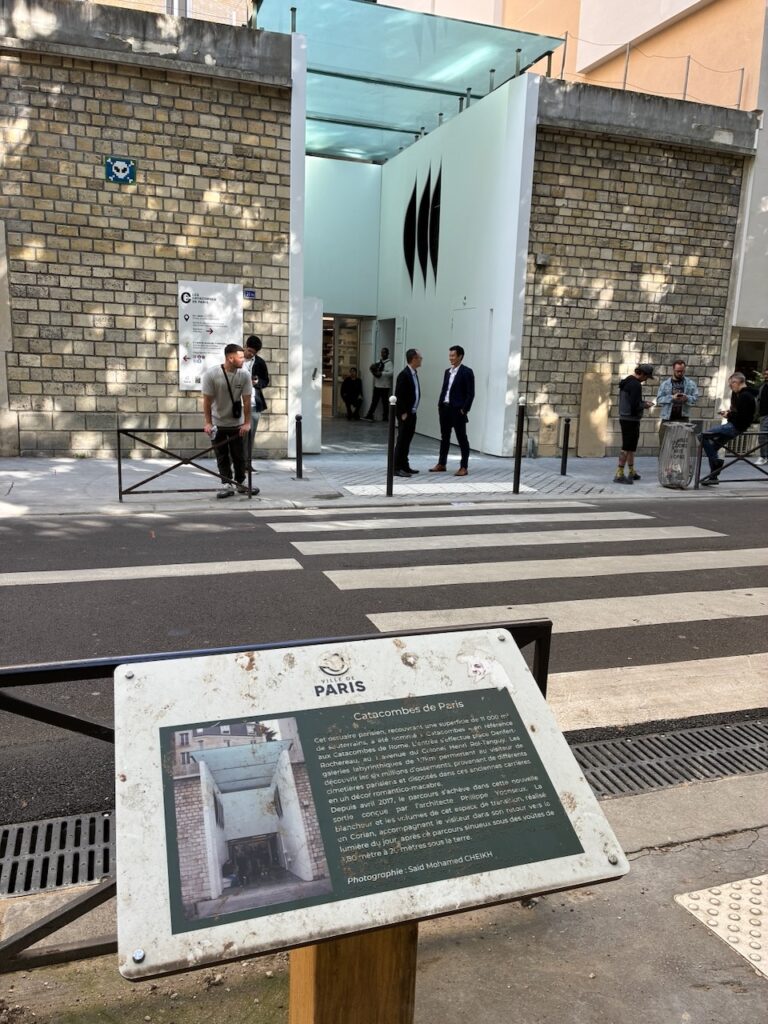
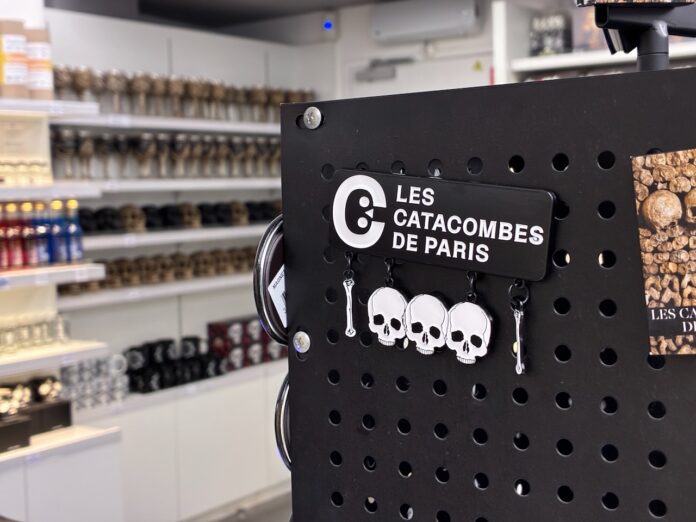

The Paris Catacombs gift shop sits at 21 bis Avenue René-Coty, and it’s the only way out. After visitors complete their underground tour, they emerge directly into this retail space. No bypass option, no alternative exit. It’s the ultimate captive audience scenario, but what makes this shop worth studying isn’t the guaranteed foot traffic, it’s what they do with it.
Getting there is disorienting on purpose. The stairs back up are spiral, not straight, and there are a lot of them, 112 of them after you’ve already done 131 going down. By the time you reach the top you’ve genuinely lost track of where you are relative to the street you started on. You come through the door still half in the headspace of what you just walked past underground, and the shop is the first thing that snaps you back.
Understanding the Attraction
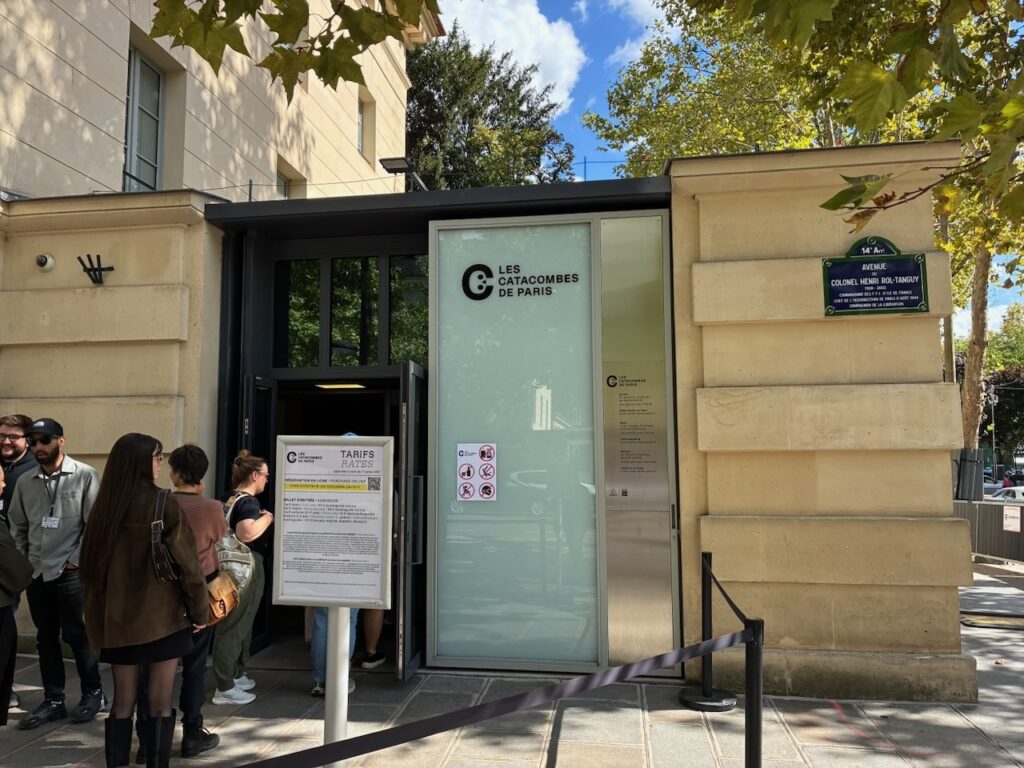
Twenty meters below Paris streets, the Catacombs contain the arranged bones of more than six million Parisians. What started in the late 1700s as a solution to overflowing cemeteries became one of the city’s most unique cultural attractions. The underground ossuary spans 1.5 kilometers of former quarry tunnels, where bones were carefully arranged into walls and decorative patterns that visitors walk past during their tour.
The experience itself is deliberately constrained and atmospheric. Only 200 visitors are allowed underground at once, creating natural scarcity that drives demand. The journey requires descending 131 steps into darkness, navigating narrow corridors at 14°C with high humidity, and climbing 112 steps back to street level. The famous entrance inscription warns visitors: “Arrête! C’est ici l’empire de la mort.” Stop, this is the empire of death.
With over 500,000 annual visitors, the Catacombs ranks among Paris’s most popular attractions despite, or perhaps because of, its macabre subject matter. It’s not the Eiffel Tower or the Louvre in terms of visitor numbers or cultural prestige, but it occupies a unique position in Paris tourism, the attraction that offers something genuinely different from the city’s classical beauty and artistic masterpieces. That positioning matters more to the shop than I expected going in.

The Room Itself Is the First Product
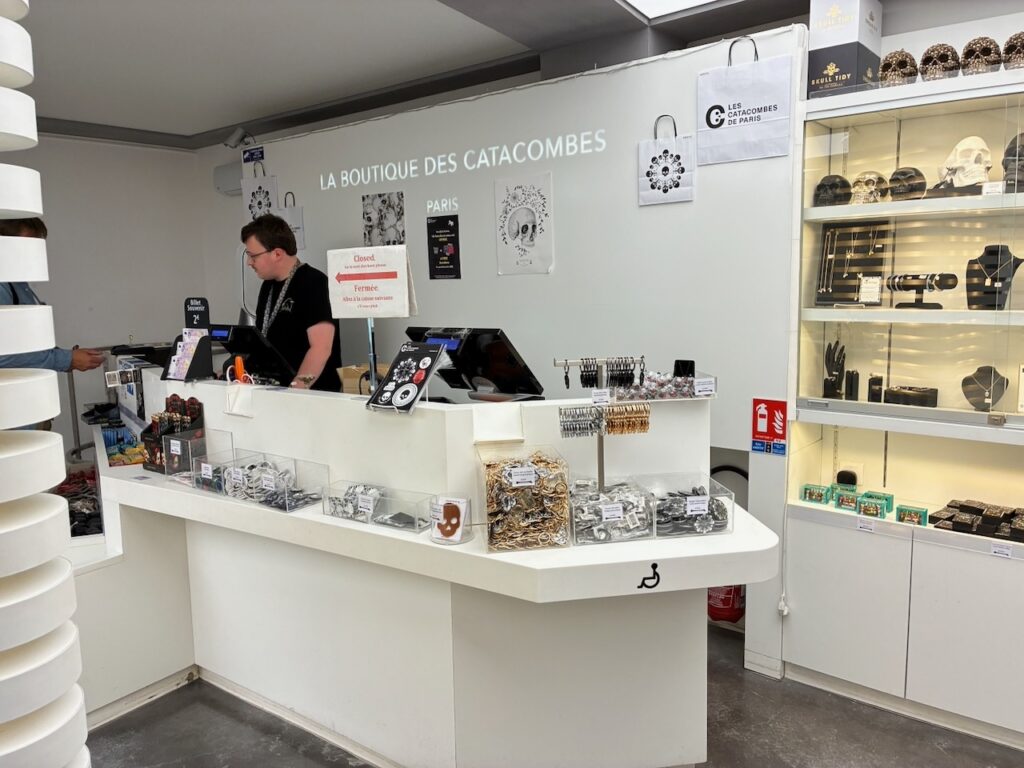
After an hour in dark, narrow, humid tunnels, you walk into a bright, open, warm room, and for a second it doesn’t compute. That contrast is not incidental, it’s the whole point of the design. The bone motif carries through in the fixtures and signage without tipping into morbid, so you haven’t left the story behind entirely, it’s just been translated into something you can hold and buy rather than something that unsettles you.
The shop is managed by Arteum, a French cultural retail operator founded in 2008 by Lorraine Dauchez. They run close to 30 locations across some of the country’s most prestigious cultural institutions. I noticed the difference the moment I walked in. Clear sightlines, visible pricing, a layout that moves you through without herding you. It’s a small space, not the smallest gift shop I’ve seen but concise, and nothing in it feels improvised.
I paid close attention to how the staff worked the floor, because it would have been easy to get this wrong here of all places. Nobody was hawking merchandise or steering people toward the register. The mood downstairs, respectful, a little heavy, seemed to follow everyone up the stairs, staff included. They were running normal retail transactions, this is their job, but there was a restraint to it that matched the room. A hard sell here would have cracked something that took an hour to build.
I also noticed the restrooms sit right off the shop floor, which quietly keeps people in the space a few extra minutes they hadn’t planned on spending there. Most people, once they’ve climbed those spiral stairs, want to walk straight through and out into daylight. The bathroom is often the only reason they don’t.
What’s Actually on the Shelves

Skulls, everywhere, but never in a way that reads as tasteless once you’ve just walked past six million of them for real. Books on the Catacombs, on underground Paris, on the history of the ossuary itself, in both English and French, because this is one of the most written about locations on the planet and there’s no shortage of material to pull from. Stickers, pins, buttons, socks, toques, the kind of small collectible that doesn’t need a whole trip to justify buying.
Prices sit in a deliberate middle ground. A sticker runs about 7 euros, which sounds like a lot for a sticker until you remember it’s not one you can get anywhere else in the world. A tote bag or a knit toque runs closer to 16 euros. None of it is cheap exactly, but none of it is trying to compete with a 40 euro Eiffel Tower snow globe or a Louvre print either. By the time most people reach this shop they’ve already spent real money at the bigger, more famous stops on their trip, and there’s something honest about a gift shop that seems to know that and prices itself into whatever’s left, rather than pretending it belongs in the same bracket.
It’s also not only a tourist shop. Locals visit the Catacombs too, and you can feel that in the product mix. The small collectible items in particular seem built for someone who might come back rather than someone passing through once. That’s probably why pins and stickers, which I’d normally write off as the laziest category in any gift shop, actually work here. They’re not filler, they’re a reason to return.
What the Eiffel Tower Shop Reveals About This One
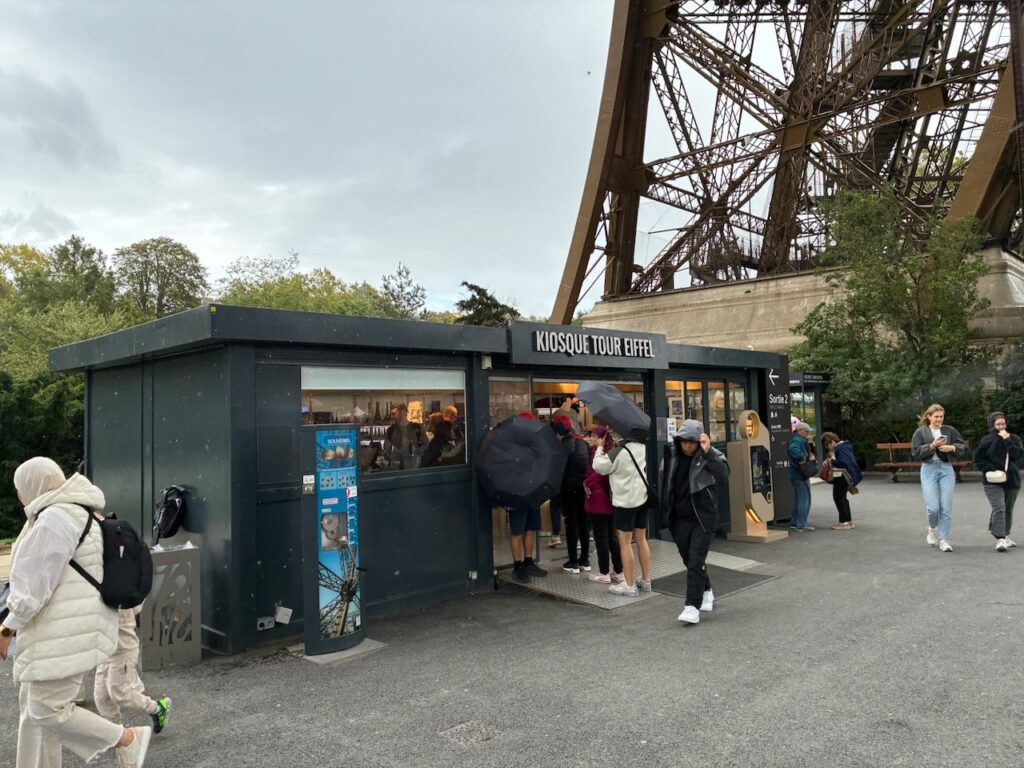
I stopped at one of Arteum’s other kiosks, at the Eiffel Tower, mostly out of curiosity once I recognized the name from the Catacombs shop. Same operator, completely different price point and completely different product. That’s not a coincidence. A visitor who’s already dropped 45 euros on an Eiffel Tower model isn’t buying another large decorative object, but that same visitor might still grab something small from the Catacombs because it’s different, it’s cheap enough not to think about, and it fits in whatever luggage space is left.
Running shops across multiple major Paris sites gives Arteum a real advantage most single-site gift shops don’t have. They can see what visitors are already carrying home from elsewhere in the city and build around it, rather than every location guessing independently at what a tourist wants.
A Board Game Built From the Building Itself

The item that actually stopped me was a Cluedo set built entirely around this location. The Catacombs partnered with Hasbro on an exclusive edition of the game, set on May 16, 1814, the night Francis I and his court supposedly entered the newly finished tunnels for the first time. The suspects are pulled from the site’s own history, the Prefect of the Seine, a Carmelite monk, a smuggler named Anne Flandrin, and the board itself uses nine actual locations from inside the Catacombs.
It’s a strange thing to see on a shelf, a board game turning a real ossuary into a murder mystery, but it works because it’s specific to this place and nowhere else. I later learned the Louvre has its own Cluedo edition too, and other Paris landmarks do the same thing, so this isn’t a one-off tie-in, it’s Hasbro quietly building a collectible set out of the city’s most famous addresses. That context made the one in front of me feel less like a gimmick and more like a genuinely clever piece of merchandising.
Built Around What the Building Won’t Allow

A few real constraints shape this shop, and it’s built around them rather than in spite of them. You can’t bring a bag bigger than 40 by 30 centimeters underground, and there’s no coat check anywhere in the building, so nothing here is designed to be big or bulky, it all has to travel with you comfortably. There’s also nowhere to store anything, which means there’s no “I’ll come back for that later.” You decide in the room or you don’t decide at all.

Why This One Sticks With Me

What stayed with me walking out wasn’t any single product, it was how consistent the whole thing felt with everything that came before it. The shop didn’t try to be a different experience from the tunnels, it tried to be the last room of the same one, translated into something bright and ordinary and priced for the version of you that’s already spent your big money elsewhere in the city.
That’s a harder thing to pull off than it looks. Most gift shops attached to a major attraction either ignore the story entirely and sell generic souvenirs, or lean on the story so hard the shop feels like a haunted house gift stand. This one found the narrow space in between, respectful of what you just saw, honest about what you’ve probably already spent, and specific enough that nothing on the shelf would make sense anywhere else in Paris.
One practical note if you’re planning your own visit rather than just reading about mine. The Catacombs has gone through full refurbishments before, and what’s open, and what’s on the shelves, can shift because of it. Book ahead and double check the current details before you go.