

Nicole Stewart has lived through every major platform shift of the past two decades. She was running digital PR campaigns when Facebook went public, editing an online magazine that got featured in The New York Times back in 2008, and teaching fashion marketing students about social media before it was even considered a real job.
Now she’s teaching university classes entirely inside virtual reality and watching her kids approach everything with an entrepreneurial mindset she never had at that age.
When we sat down for The Immersive Lab, Stewart brought a perspective on immersive retail that combines hands-on VR experience with real-world business expertise. Having run her own PR firm for seven years before entering academia, she understands both the promise and the pitfalls of new technology.
The Moment Students Stop Seeing VR as a Gimmick
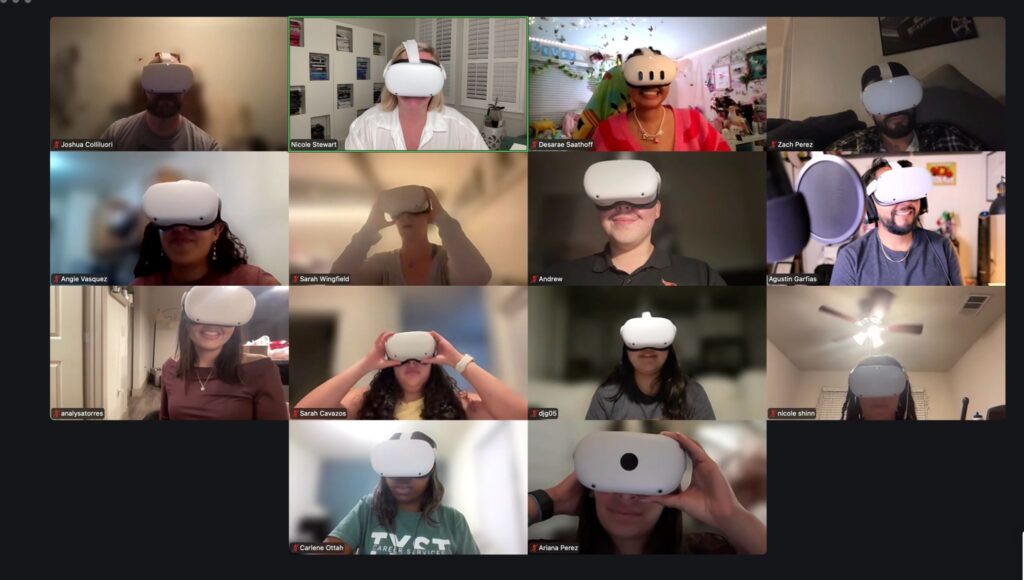
Stewart made headlines teaching Canada’s first university class entirely in VR, but the real breakthrough came when her students stopped thinking about the technology altogether.
“It felt like the digital hands were my hands,” they started telling her. Not immediately—this took time. But once students reached this point of embodiment, everything changed. They collaborated differently. They stayed focused longer. They explored virtual spaces like they were real places.
“When someone’s shopping in VR and they reach that level of embodiment, they really feel like they’re touching products,” Stewart told us. “That changes their buying behavior completely compared to clicking ‘add to cart’ on a screen.”
Most retail VR experiences never get to this point. They feel like 3D websites because that’s essentially what they are. Stewart’s classroom research suggests the difference between successful and failed VR retail comes down to this psychological shift from “using technology” to “being present in a space.”
Platform Migrations Nobody’s Tracking
Stewart’s academic work focuses on how communities form around digital platforms, but her personal observations as both professor and parent reveal shifts that industry reports are missing.
Take Facebook. Everyone assumes young people abandoned it for their parents. But Stewart’s seeing something different in Texas: “We’re actually seeing a lot of younger people starting to shift back to Facebook. I had kind of written that one out as the boomer generation and now I’m like, huh, I’m going to have to rethink that.”
More concerning for retailers obsessed with TikTok and Instagram: “I think Fortnite will continue to hold, and Minecraft. These are maybe two spaces that people don’t think enough about for that next shopping generation.”
While brands chase social commerce on traditional platforms, an entire generation is developing purchasing behaviors inside gaming environments. Stewart’s watching this happen in real time through her children and their classmates.
The AI Influencer Economy You’re Not Seeing

Stewart maintains a database of AI influencers on Instagram. Some are making millions annually through brand partnerships with companies like Coach and Burberry. Many of their followers don’t realize they’re engaging with artificial personas.
This isn’t theoretical research. Stewart recently created an AI influencer for her students to analyze and recreate—the entire process took less than a day. “I want them to critique the ethics of creating a persona and trying to monetize this persona in this public space,” she explained.
Her concern isn’t just about fake influencers. It’s about her students losing the ability to distinguish authentic content from AI-generated material. “They used to be like, I can tell, and you put things in front of them and most of the time they’d be right. And now I do this exercise and they’re like, ‘I have no idea.'”
For retailers entering immersive spaces, this erosion of critical thinking skills presents both opportunity and responsibility.
The 3D Printer Generation

Stewart’s household offers a window into how the next generation approaches technology and commerce. Her kids—ages 9 and 11—have coded AI chatbots, take VR classes at school, and think entrepreneurially about everything they encounter.
“There is not a boy in my kid’s grade five class who didn’t have a 3D printer,” she told us. “My son’s like, I could sell that. I could monetize it. I’m like, you’re 11, you’re not supposed to be doing this yet.”
This generation doesn’t see technology as separate from shopping—it’s all one integrated experience. They expect to build, customize, and monetize everything they touch.
But they’re also pragmatic about risk. Despite understanding influencer potential, Stewart’s son plans to be a lawyer “because it’s a steady paycheck” while running “several businesses on the side.”
AR vs. VR: The Honest Assessment
Despite her VR expertise, Stewart’s recommendation for most retailers is surprisingly practical. When we asked about VR versus AR for retail, her answer was immediate: “AR. AR for sure. 100% right now people are not quite ready for VR.”
The exception? “If you’re talking about younger generations like the 14 and under boys, VR for NFT skins, avatars—that’s the sale for sure.”
Her advice reflects something Stewart learned from teaching fashion marketing before transitioning to academic research: you have to meet your audience where they are, not where you think they should be.
The Human Touch Problem

Stewart’s biggest frustration with current AI implementations comes from her experience running a PR firm. She knows what good customer service feels like, which makes today’s chatbots particularly irritating.
“It is so irritating to talk to a bot that can only speak like three sentences and not be able to answer you,” she said during our conversation. “It makes me not want to work with a brand.”
But her criticism isn’t anti-technology. Stewart sees clear value in automation for efficiency—she mentioned Amazon’s facial recognition checkout as an example of AI done right. The problem is brands replacing human problem-solving with algorithmic shortcuts that don’t actually solve problems.
“People actually usually make the sales,” she pointed out. “I’m not going to buy into a machine. I will buy into you because I believe in you.”
Social Listening: The Lost Art
When we asked about underrated tech trends, Stewart’s answer revealed something many brands are getting wrong: “I think social listening—I don’t think brands are doing it very well right now. It’s like they’re letting AI do it instead of having a person who’s actually in charge.”
This observation comes from someone who spent years managing social media for lifestyle brands. Stewart knows what authentic engagement looks like, and she’s watching brands lose that capability by over-automating customer interactions.
The Storage Strategy That Actually Works
An unexpected part of our conversation revealed Stewart’s approach to content archiving—something relevant for any brand building libraries of immersive experiences.
“I do save everything that I’ve ever taken,” she told us, describing a multi-layered backup system including private cloud storage and automatic syncing. “You don’t know if you’re gonna want to go back five years, 10 years. Maybe you’re gonna do a vintage comeback of an item at some point.”
Having run a digital magazine and PR firm, Stewart understands the value of content libraries. Her academic work now requires managing terabytes of research data, but the principles remain the same: store everything, sync everywhere, and maintain control over your digital assets.
The Future Split
Stewart sees retail evolving in two clear directions, and she doesn’t think there’s much middle ground.
“Remote,” she said when we asked about retail’s future. But she immediately added a crucial caveat: “Luxury brands always need to offer an experience and that experience is personal, not personalized through an algorithm.”
This distinction—personal versus personalized—emerged as a key theme throughout our conversation. Algorithms can recommend products based on data patterns, but only humans can create genuine personal connections.
Stewart’s prediction: successful retailers will either embrace full automation for efficiency or double down on premium personal experiences. The brands trying to be somewhat automated and somewhat personal will lose to competitors who pick a clear direction.
The Bigger Picture
What makes Stewart’s perspective valuable isn’t just her VR research—it’s her combination of academic rigor and business experience. She’s run campaigns for lifestyle brands, edited publications, taught fashion marketing, and now researches platform behavior at the university level.
This background gives her insights that pure technologists miss. She understands why embodiment matters in VR because she’s watched students experience it. She knows why authentic human connection matters in retail because she’s built those relationships for clients. She recognizes platform shifts because she’s lived through multiple cycles of social media evolution.
As she put it near the end of our conversation: “The job that you’re going to have in 10, 15, 20 years from now does not exist yet. Don’t be afraid to go make the job.”
Stewart’s students are preparing for careers that don’t exist yet. The retailers who understand this will be the ones creating those opportunities—and capturing the customers who expect immersive, interactive shopping as the standard.
Dr. Nicole Stewart is Assistant Professor of Digital Media at Texas State University and Director of the Digital Media and Everyday Life Lab. Before academia, she ran Nicole Stewart PR and served as Editor of GLOSS Magazine. Connect with her on LinkedIn for ongoing insights into platform studies and immersive technology research.